Stewart Ennis’ strong debut novel Blessed Assurance is a coming of age story set in a Scottish evangelical community in the midst of the Cold War. It follows the troubled Joseph Kirkland, whose casual lie that he has been ‘saved’ by Jesus quickly spirals out of control. As Joseph heads towards disaster, secrets long buried by his family and community come careening dangerously to the surface.
In his depiction of the fictional village of Kilhaugh, Ennis perfectly captures the claustrophobia of small town life. There is a distinct feeling of a world on the brink of collapse, either through the erosion of the beliefs on which the community is founded or from the ever-present threat of nuclear war.
With its simmering tensions and bloodstained bibles, Blessed Assurance reads like a Flannery O’Connor story with a distinctly Scottish twist. Ennis’ use of Scots language words makes the dialogue shine and makes a contribution to much needed linguistic diversity in British writing.
The emotional heart of the story is Joseph’s relationship with his best friend Archie Truman, a kind-hearted juvenile delinquent from the “Glasgow spillover”. Their friendship challenges Kilhaugh’s rigid class divisions and the hypocrisy of its religious leaders. In this tragicomic tale of faith, grief and redemption, Blessed Assurance reminds us that ultimately it is people, and not religion, that will save us.
Blessed Assurance is published by Scottish indie publisher Vagabond Voices. You can buy the book directly from them here. Review copy provided by the publisher in return for an honest review.
When I was a small child, whenever my mother was ferrying our family from place to place she would get us all to join in chanting the poem ‘We’re Going On A Bear Hunt’. You probably know it:
We’re going on a bear hunt, we’re going to catch a big one. What a beautiful day — we’re not scared!
This verse was so ubiquitous in my household that it was only years later, when I was working as a kindergarten teaching assistant, that I realised it was from a picture book by Michael Rosen and not something my mother made up. Nowadays whenever it pops into my head, which is often, I’m hit with a wave of nostalgia. Those words fill me with confidence, the sense that there’s a big wide world out there just waiting for me to explore. Those words make me brave.
One year ago, I started as an intern at the small independent picture book publisher Tiny Owl. I had previously only done two short work experience placements in publishing and I felt woefully underprepared. Finding your first role in publishing is notoriously difficult — I wish I had a secret trick to share but unfortunately it was just a case of sending out applications until I got lucky.
I’m incredibly grateful to the team at Tiny Owl, especially Commissioning Editor Sophie Hallam for showing so much kindness and patience towards someone just starting out in the industry. I’ve learnt so much in the past year, but most of all this job has reminded me to see picture books as valuable artistic and literary works in their own right. My own life has been hugely shaped by the books I read as a child – getting to play a part in creating the books that will shape the next generation has been a hugely rewarding experience. I will be leaving my job at the end of September, and venturing out into the unknown.
I don’t know where I’ll be going next, but I’m not scared.
Matthew Haigh’s poetry collection Death Magazine peels back the glossy exterior of ‘wellness’ culture to reveal the skull beneath the skin. Using Dadaist cut-up techniques, he has created an otherworldly mirror version of the lifestyle magazine that feels disturbingly familiar.
The collection is laid out like a magazine, with sections addressing different aspects of the human condition: fitness, lifestyle, beauty, wellness and advice. The ‘Fitness’ section comprises absurdist versions of male celebrities’ workout routines, their Patrick Bateman-esque weirdness satirising the unrealistic standards of masculine beauty offered by men’s magazines. In the ‘Wellness’ section, poems like ‘What Will Your Sims Do Now?’ explore the deep strangeness of the way we experience death in the contemporary era, now that we will all be outlived by our data footprint.
Haigh’s use of cut-up reaches heights of comic absurdity in ‘Interview with a New Father’, juxtaposing the bland soundbites attached to the idea of ideal fatherhood with the rawness of human vulnerability.
Death Magazine pushes back against the lie peddled by the lifestyle industry that with the right diet, fitness regime and skincare routine, death can somehow be evaded. These blackly humorous poems give an incisive yet touching look at what it means to be human in a post-human age.
A copy of the book was given to me by the author in return for an honest review. Buy a copy from Salt Publishing here.
If you like books and you’re on Twitter, you’ve probably seen this article concerning Gwyneth Paltrow and her ‘celebrity book curator’, the brilliantly named Thatcher Wine.
Thatcher “sources rare, out-of-print books to build beautiful libraries based on interest, author, and even colour for his clients”. His services include custom book jackets, allowing his clients to have all their books match the colour scheme of the room they’re in or display an image.
A curated bookshelf by Juniper Books
The first thing that struck me about the article was that it’s ridiculous, and that some people really do have too much money for their own good. The second thing was that it was incredibly insulting to book designers. The book curator (and by the way, didn’t they used to be called librarians?) said in his interview: “Why settle for books that a publisher designed?”
Well. Because publishers expend a lot of time and effort making sure their books look attractive and reflect their contents. Because book design is an art form that balances aesthetics with conveying information.
When we make book ownership all about aesthetics, we lose something. It might be nice to have all your books covered in the same Pantone colour to match your bedroom, but it makes it a lot harder to pick out that exact poetry collection that you really feel like rereading at one in the morning when you can’t sleep. The same goes for turning your books so the spine faces away from you (I’m looking at you, Bobby from Queer Eye). I’m reminded of the scene in The Great Gatsby in which it’s revealed that all of Gatsby’s books are genuine, but the pages remain uncut — they’ve never been read.
Of course, this is nothing new. A personal book collection has always been a symbol of cultural capital, as historically only the wealthy could afford to access an education or buy their own books. The books we own stop being a resource to be used, and begin to act as a projection of our identity and class status. As the existence of celebrity book curators shows, books are aspirational. Nowadays, book lovers display their collections by sharing a #shelfie (a photo of their bookshelf) on social media. When you peruse this hashtag, expect displays of books carefully arranged with concrete planters and copper picture frames: Still Life With Books, 2019.
Bespoke matching sets of books are nothing new either. Until the 1820s, you couldn’t go into a bookshop and buy a book already tucked in a nice jacket. Books were sold unbound, sometimes wrapped in paper or held together with temporary board covers. Covers were hand-bound, and those who could afford it would commission a cover to be made for them. This meant that, à la Paltrow, wealthy readers could order beautiful matching bindings for every book in their personal library.
Persephone Books in Lamb’s Conduit St, Holborn. Photo by The Independent.
With the rise of the e-reader, many predicted an end to the love of books as aesthetic objects. Instead, the obsession only seems to be increasing. If you’d like your own matching book collection but can’t afford to hire your own Thatcher Wine, there are some great alternatives. There’s Vintage Classics with their iconic red spine, or you could opt for an indie collection. Persephone Books reprint forgotten twentieth century classics, mostly by women, all in an elegant dove grey jacket with beautiful endpapers. Fitzcarraldo Editions publish an eclectic mix of fiction and essays, with covers that satisfy the need for uniformity — blue with white text for fiction, white with blue text for essays.
Or, we could be old school and choose our books based on what’s inside them.
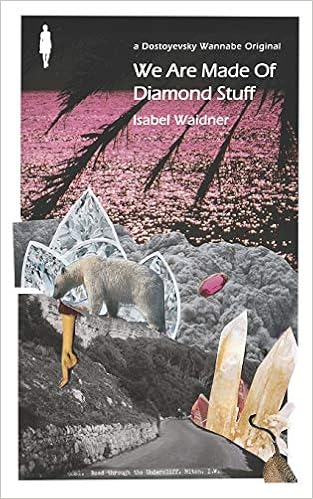
Isabel Waidner’s We Are Made of Diamond Stuff came highly recommended from a friend, with the caveat that it was “quite weird”. I wasn’t disappointed.
Waidner’s protagonist — the unnamed 36 year old lookalike of Eleven from Stranger Things — and their friend Shae are both migrant workers struggling to survive in a characteristically grim off-season seaside town on the Isle of Wight. Their world stubbornly refuses to cohere into a single reality. Images of polar bears bleed from Shae’s jumper into the real world, Reebok classics transform into their animal namesake and start running around, and a character from BS Johnson appears in the form of their corrupt and tyrannical boss. (There’s a strong intertextual relationship with the novel House Mother Normal by the experimental writer BS Johnson, but you don’t need to have read it to understand what’s going on.)
Waidner’s absurd, darkly comic prose unflinchingly tackles the harsh reality of life for queer migrants pushed to the edges by Brexit Britain. The phrase “hostile environment” has never felt more apt. They also construct and incisive and sorely-needed critique of queer culture in UK, its co-opting by right wing movements and the impact of respectability politics. Diamond Stuff marks out the battle-lines in our increasingly confused and violent culture wars. In the face of all of this, its characters keep fighting.
No other novel I’ve read has so sharply captured the strangeness of our current political moment. The narrative refuses to resolve itself — there are no resolutions for the mess we’ve put ourselves in. Furiously preoccupied with the now, We Are Made of Diamond Stuff is set to be one of the defining novels of the Brexit era. Essential reading.
In her debut novel, Djinn Patrol on the Purple Line, Deepa Anappara examines the epidemic of missing children in India through the eyes of a naïve, TV-obsessed young boy living in the slums. When a boy from Jai’s school goes missing, he decides to use his detective skills learned from watching too many episodes of Police Patrol to find him.
This was a book that confounded many of my expectations. Based on the premise of djinns in contemporary society, I was expecting a magical realist depiction of life in India, in the vein of Rushdie’s Midnight’s Children. In fact, Anappara’s terse, utilitarian style owes a lot more to true crime writing. This is perhaps to be expected, given her background as a journalist reporting on cases of disappeared children. While we’re occasionally reminded of the story’s supernatural elements, they jar somewhat with the central narrative, never quite fitting together.
Anappara creates a rich cast of characters, each struggling to survive in the face of poverty, police corruption and religious conflict. Jai’s sister Runu, who has ambitions of becoming a star athlete, and his academically gifted friend Pari chafe against the limitations placed on women in their society. While the women are the emotional heart of the novel, they feel oddly de-centred.
The novel is structured around the events of each disappearance, written from the victim’s perspective, but focuses on the ‘everyman’ protagonist Jai, in many ways the least interesting character. His limited perspective and lack of understanding give the novel a frustratingly narrow view of the world it depicts. I would have loved to see a more in-depth exploration of the other characters’ inner lives and everyday experiences.
While the tagline reads, “This story is a talisman. Hold it close to your hearts,” the novel never quite delivers on this idea of the redemptive power of storytelling, instead falling into a sadly realistic but narratively unsatisfying conclusion. As many as 180 children go missing in India every day, and despite its imperfections, Djinn Patrol will hopefully bring much needed international attention to this issue.
Review copy provided by the publisher in return for an honest review
Djinn Patrol on the Purple Line is out in the UK from Chatto & Windus on 30th January 2020
There’s been a sudden, although long overdue, surge in films by and about lesbians. They’ve hit the mainstream so hard in the last few years that even my late-fifties, Sunday Times-reading mum saw The Favourite (2018) in the cinema, of her own accord. (She didn’t really like it.)
Many of these films have been adapted from novels, often from the backlist of women more famous for other works. These adaptations have the benefit of bringing these novels to a wider audience and bringing much-needed income to the author. However, they also bring up the thorny issue of how to best translate queer women’s words into a visual medium like film in a way that does them justice.
To illustrate this problem, I’m going to talk about two films: the almost universally lauded Carol (2015) and the well-received Disobedience (2017).
In both of these stories, two women enter a relationship that goes against the homophobic norms of their society and must make a choice between conformity and choosing to live authentically.
In both film adaptations, significant changes are made to the source material, both novels written by women. One detail that caught my attention in the way both novels were adapted was that in both, the protagonist’s profession is changed. Originally, The Price of Salt’s Therese is an aspiring theatrical set designer, and Disobedience’s Ronit is a high-flying financial analyst. In the film adaptations, they have the same job: photographer.
In both films, this change signals a refocusing on the visual as a source of meaning. In The Price of Salt, seeing and being seen are inherently linked to power and control. When Therese first sees Carol, “their eyes met at the same instant…her eyes were grey, colourless, yet dominant as light or fire, and, caught by them, Therese could not look away.” Highsmith is acutely aware of the power that can be exerted by vision and recognition. In the case of queer women being seen and recognised by the heterosexual world, it is an oppressive force. Yet between Therese and Carol, it is the tender sense of recognition and familiarity when she meets the woman she will love.
For queer women in 1950s America, to be seen and identified is to become the subject of homophobic discourse. Perhaps more than in any other period of American history, the 1950s were marked by intense public homophobia, linked to the ‘lavender scare’ which took place as a result of Cold War political paranoia. Being seen was dangerous, a danger echoed in the anxiety felt by Disobedience’s Esti and Ronit about being visibly queer in their Orthodox Jewish community.
The way these films, and the inevitable tie-in reissue of the novels, are marketed is also significant. Film tie-ins seem to love intense close-ups for their jackets. As one friend commented at my book club when we discussed Disobedience,“it’s all face”.
Does focusing so heavily on the movie-star good looks of the actors detract from the original meaning? More importantly, when will we see a major lesbian film that’s not about beautiful people falling in love?
Another significant change is that both adaptations added explicit sex scenes that were only implied in the source material.
While these are both valid artistic choices by the filmmakers — which in the case of Carol simply fills in an aspect of the story that would have been difficult to get past censors when the source novel The Price of Salt was published in 1952 — they also represent a refocusing of the narrative. While The Price of Saltwas always a romance, albeit one with a more noirish edge than the softer film adaptation, the novel Disobedience is about nostalgia, community and faith. The romance between Esti and Ronit has long passed, leaving a tale far more interesting and nuanced than a classic “forbidden love” narrative. This feels lessened in the film, possibly to its detriment.
It’s also surely problematic that the big closing speech of the novel, given by Esti who breaks the convention against women speaking in the synagogue, is in the film given to her husband Dovid. The power of words and their importance in the Jewish faith is a central theme in Disobedience, so this feels like a betrayal of the novel’s intentions.
What’s at stake here is the question of whether queer women are merely seen and not heard, or whether they can have a real voice in mainstream film. An obvious solution is to hire more lesbian and bisexual women to direct for these projects. Yet that seems like too reductive a solution, especially when the brilliant and sensitive adaptation Carol was directed by a gay man, Todd Haynes.
Now that there’s space for these films to exist in the mainstream, it would be wonderful to see more high-profile films about queer women that aren’t love stories. A great example of this would be 2018′s Can You Ever Forgive Me? in which Melissa McCarthy plays author and literary forger Lee Israel, whose queerness is important to the film but not its central theme.
While Carol soars, I would consider Disobedience to be a decent film but a poor adaptation. But perhaps that’s okay. Until quite recently, lesbian and queer-centric films haven’t had room to fail without it being seen to reflect poorly on all such films. Now that there’s more space to breathe, we can only hope that lesbian films will be judged on their own artistic merits and not on how well they succeed in representing the community. There’s a wealth of source material out there just waiting for a great film adaptation. Let’s hope that the next lesbian blockbuster (could you imagine saying that even five years ago?) will be treated with sensitivity, and take bigger risks than ever before.
As a huge fan of the brilliant yet elusive photographer Vivian Maier, I was very excited to pick up the fictionalised account of her life Vivian by Christina Hesselholdt. The author examines the life of this mysterious outsider artist, whose vast body of photographs were unknown until shortly before her death, when the negatives were discovered in a storage unit and sold at auction. Viviangives glimpses of her childhood in rural France and the US, her dysfunctional family, her employment as a nanny in Chicago and her work as a street photographer. Hesselholdt weaves vivid scenes from her photographs into the narrative, fictionalising the circumstances in which they were taken.
Self-Portrait; October 18, 1953, New York, NY, Vivian Maier
Like Maier’s self-portraits, which often show the artist half out of frame or half in shadow, this portrait of her life is at times frustratingly incomplete. We’re only privy to snapshots, which when put together resist being formed into a coherent narrative. Instead Hesselholdt has created a polyphonic chorus of voices, mostly female, who work together and in opposition to form a compelling life study of a woman no one could ever truly understand.
As many details of Maier’s life still remain unknown, Hesselholdt lets these absences become part of the narrative, at times filling them with the voice of the intrusive Narrator, a woman living in the present day. Her anachronisms, including references to Google searches and YouTube videos, add to the fragmented structure. Although these things existed in Maier’s lifetime (she died in 2009), they feel a world away from the haunting street scenes of 1950s Chicago we most associate with her.
Undated, Vivian Maier
There are biographies and documentary films that give a much clearer picture of the events of Vivian Maier’s life than this novel, but none of them capture her true appeal: her unknowability. With her idiosyncratic and powerful narrative, Hesselholdt creates a fascinating portrait of an artist who resisted fame, and whose inner life is fated to remain opaque.
Vivian, by Christina Hesselholdt, translated by Paul Russell Garrett, Fitzcarraldo Editions, RRP £12.99, 192 pages
Welcome to my blog, where I’ll be sharing my thoughts on books old and new, and other related and less-related subjects. Expect plenty of queer literature, graphic novels, poetry, translated literature and film. I may also post some good old-fashioned book reviews from time to time. I hope you enjoy them!




 Book, Bell & Candle